Auspurg, Katrin. 2025.
“Robustness Is Better Assessed with a Few Thoughtful Models Than with Billions of Regressions.” Proceedings of the National Academy of Sciences 122 (43): e2521917122.
https://doi.org/10.1073/pnas.2521917122.
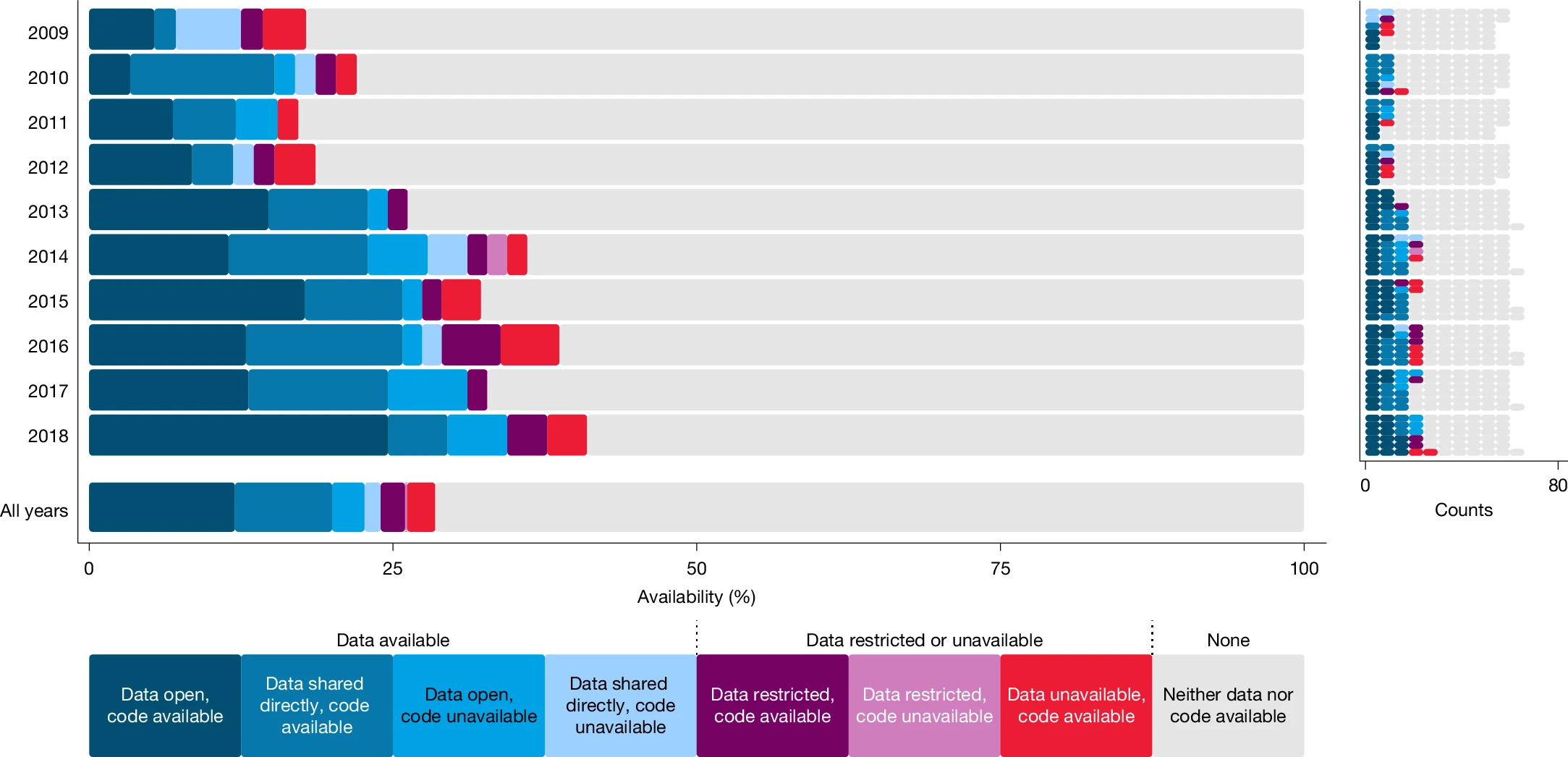
Brodeur, Abel, Derek Mikola, Nikolai Cook, et al. 2026.
“Reproducibility and Robustness of Economics and Political Science Research.” Nature 652 (8108): 151–56.
https://doi.org/10.1038/s41586-026-10251-x.
Devezer, Berna, Luis G Nardin, Bert Baumgaertner, and Erkan Ozge Buzbas. 2019.
“Scientific Discovery in a Model-Centric Framework: Reproducibility, Innovation, and Epistemic Diversity.” PloS One 14 (5): e0216125.
https://doi.org/10.1371/journal.pone.0216125.
DuBois, James M. 2024.
Sharing Qualitative Research Data: Survey of Qualitative Researchers, United States, 2019: Version 1.
ICPSR - Interuniversity Consortium for Political and Social Research.
https://doi.org/10.3886/ICPSR38957.V1.
Heaton, Janet. 2008.
“Secondary Analysis of Qualitative Data: An Overview.” Historical Social Research 33 (3).
https://www.jstor.org/stable/20762299.
Lamb, Danielle, Amy Russell, Nicola Morant, and Fiona Stevenson. 2024.
“The Challenges of Open Data Sharing for Qualitative Researchers.” Journal of Health Psychology 29 (7): 659–64.
https://doi.org/10.1177/13591053241237620.
Meehl, Paul E. 1990.
“Why Summaries of Research on Psychological Theories Are Often Uninterpretable.” Psychological Reports 66 (1): 195–244.
https://doi.org/10.2466/pr0.1990.66.1.195.
Miske, Olivia, Anna Lou Abatayo, Mason Daley, et al. 2026.
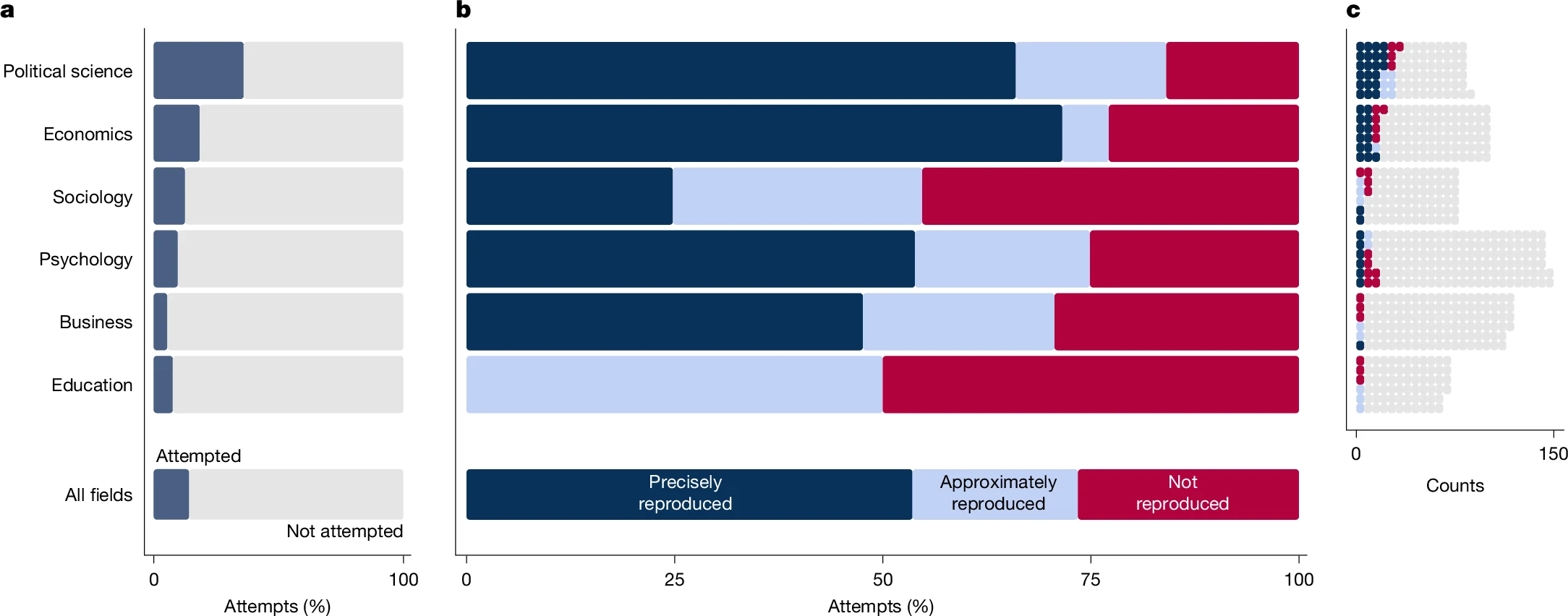
“Investigating the Reproducibility of the Social and Behavioural Sciences.” Nature 652 (8108): 126–34.
https://doi.org/10.1038/s41586-026-10203-5.
Morin, Edgar, and Anne Brigitte Kern. 1999. Homeland earth: a manifesto for the new millenium. Advances in systems theory, complexity, and the human sciences. Hampton Press.
Open Science Collaboration. 2015.
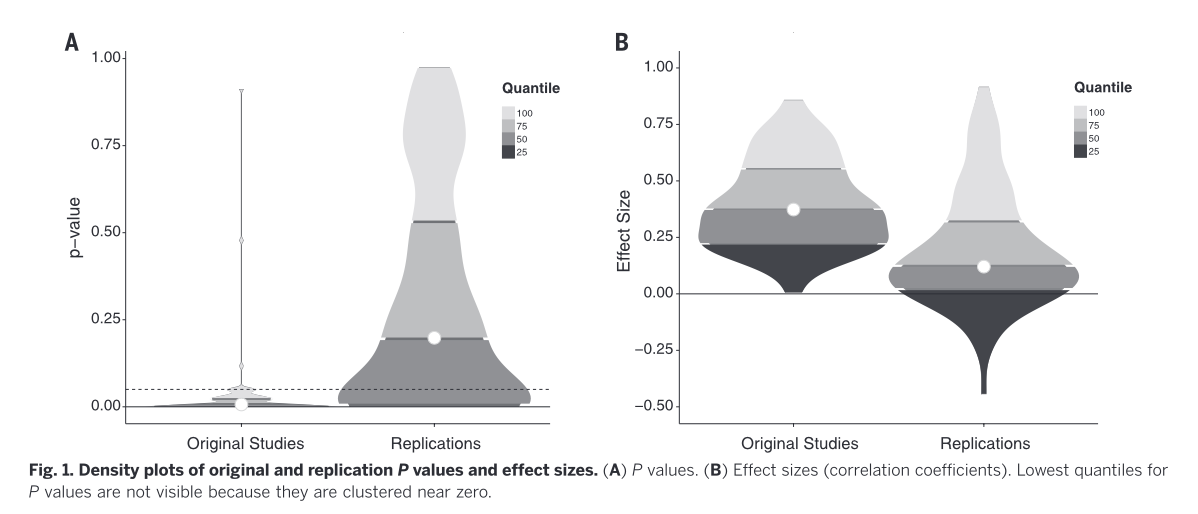
“Estimating the Reproducibility of Psychological Science.” Science 349 (6251): aac4716.
https://doi.org/10.1126/science.aac4716.
Pashler, Harold, and Eric-Jan Wagenmakers. 2012.
“Editors’ Introduction to the Special Section on Replicability in Psychological Science: A Crisis of Confidence?” Perspectives on Psychological Science 7 (6): 528530.
https://doi.org/10.1177/1745691612465253.
Scheel, Anne M. 2022.
“Why Most Psychological Research Findings Are Not Even Wrong.” Infant and Child Development 31 (1): e2295.
https://doi.org/10.1002/icd.2295.
Tooze, Adam. 2023.
“Welcome to the World of the Polycrisis.” Financial Times 28 (10).
https://www.ft.com/content/498398e7-11b1-494b-9cd3-6d669dc3de33.
Yarkoni, Tal. 2022.
“The Generalizability Crisis.” Behavioral and Brain Sciences 45.
https://doi.org/10.1017/s0140525x20001685.